
Pride, Pressure and Personal Sacrifice: The State of Australian Small Business Owners 2026
Small businesses are an incredibly important part of the economy, making up around 97% of all businesses in Australia. Running a small business is often associated with ambition, freedom, independence and success. However, this is only part of the story.
To better understand the realities facing small business owners today, BizCover surveyed 1,500 Australian small business customers in April 2026. The findings reveal a complex picture of modern business ownership: while many owners remain deeply proud of what they have built and strongly connected to their business, these feelings often exists alongside significant pressure.
Brad Miller is the General Manager of BizCover. He understands that running a business of any size is about far more than revenue or operations alone.

“Behind every small business in Australia is a person balancing responsibility, uncertainty and ambition, often all at once. This can be a lot to carry, especially when you take into consideration the current economic climate as well as other personal goals, like buying a home or raising a family.”
This report aims to explore the findings of the abovementioned survey, taking a look at the personal realities of entrepreneurship in modern Australia and offer an in-depth snapshot of the state of small business owners in 2026.
Key takeaways
- 31.7% of Australian small business owners have never taken a single week off while running their business. Among owners working 60+ hour weeks, that rises to 60%.
- 64.3% of owners have experienced financial stress from their business in the past year, while 61.3% worked through illness rather than taking time off completely.
- Owners aged 30–39 report the highest levels of regret of any age group (28.6%), alongside the highest levels of significant financial stress (30.2%).
- More than half of owners (50.8%) have considered closing or selling their business at some point.
- Two in three owners (65.9%) say the realities of running a small business are not really understood by others.
- Despite the pressure, 85.4% of owners surveyed remain proud of what they have built and 78.7% say they have never regretted starting their business.
- Only 10.5% of owners say financial reward is the most satisfying part of running a business, highlighting that pride and purpose trump profit.
- When reflecting on hindsight, owners are most likely to say they would have set clearer work boundaries (43.5%), sought more support or mentorship (38.2%), or built stronger financial reserves before starting (35.5%).
State of small business owners 2026
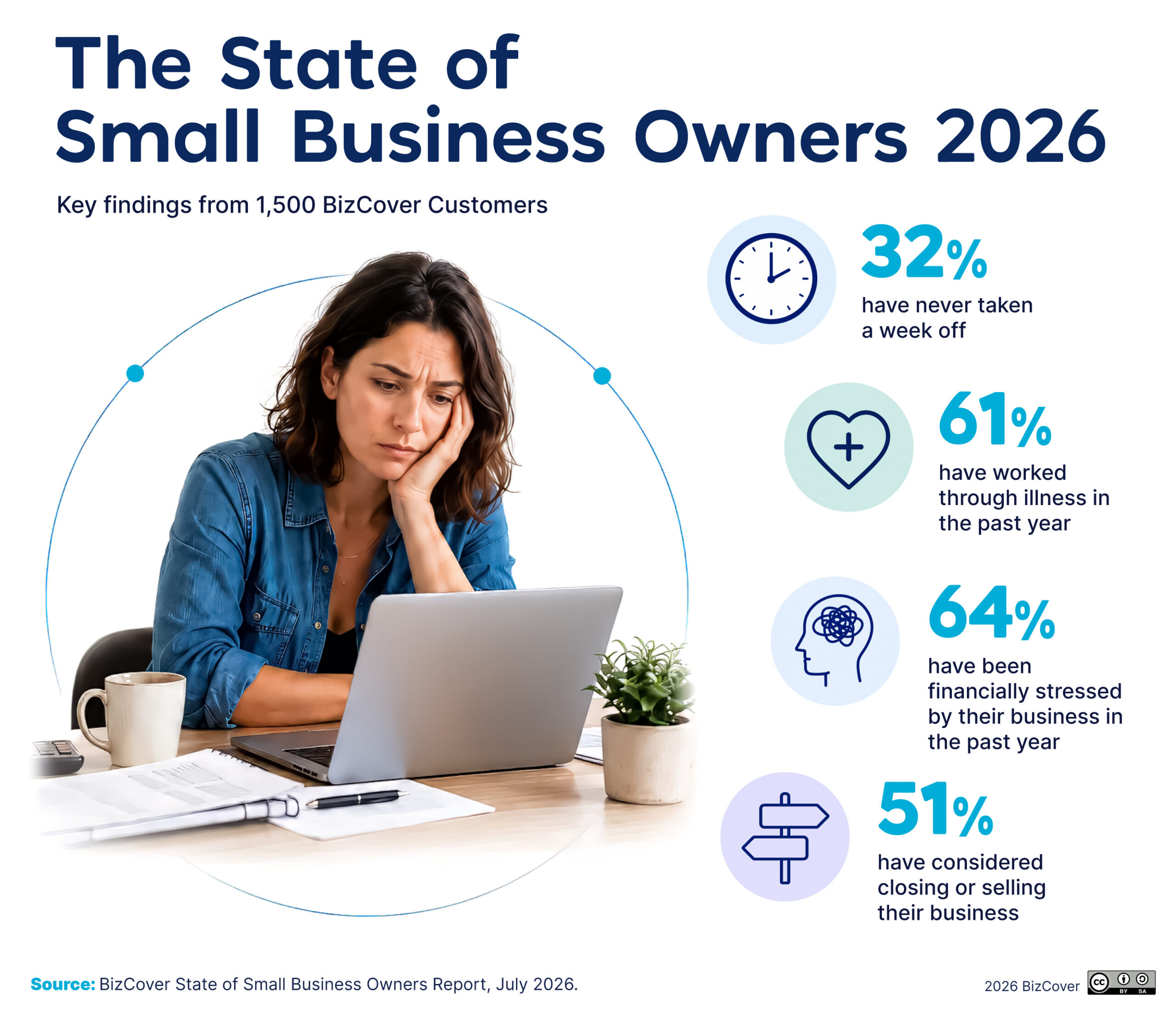
Many Aussie small business owners are very connected to the businesses they’ve built. However, behind that is a growing level of financial stress, exhaustion and long-term pressure that many owners are silently shouldering.
One of the clearest indicators of this pressure is the lack of time away from work. Nearly one in three business owners (31.7%) say they have never taken a single full week off while running their business. At the same time, 61.2% worked through illness during the past year rather than taking time off completely, highlighting how difficult many owners feel it is to step away from their business responsibilities even temporarily.
Financial pressure also continues to weigh heavily on the sector. Almost two thirds of owners (64.2%) report experiencing financial stress from their business in the past 12 months. Meanwhile, just over half (50.8%) say they have thought about closing or selling their business at some point or would consider it in the future.
Taking the good with the bad
Yet despite these pressures, almost four in five owners (78.7%) say they have never regretted starting their business, while 74.6% remain optimistic about the future of their business over the next 12 months.
Interestingly, while 21.3% say they have regretted starting their business at some point along the journey, only 7.8% say they still feel that way today.
“Small business owners are incredibly resilient, but resilience doesn’t mean the pressure isn’t there,” says Miller. “What stands out in this research is that many owners remain deeply committed to their businesses despite experiencing financial stress, long working hours and personal sacrifice behind the scenes.”
The 60-hour week effect
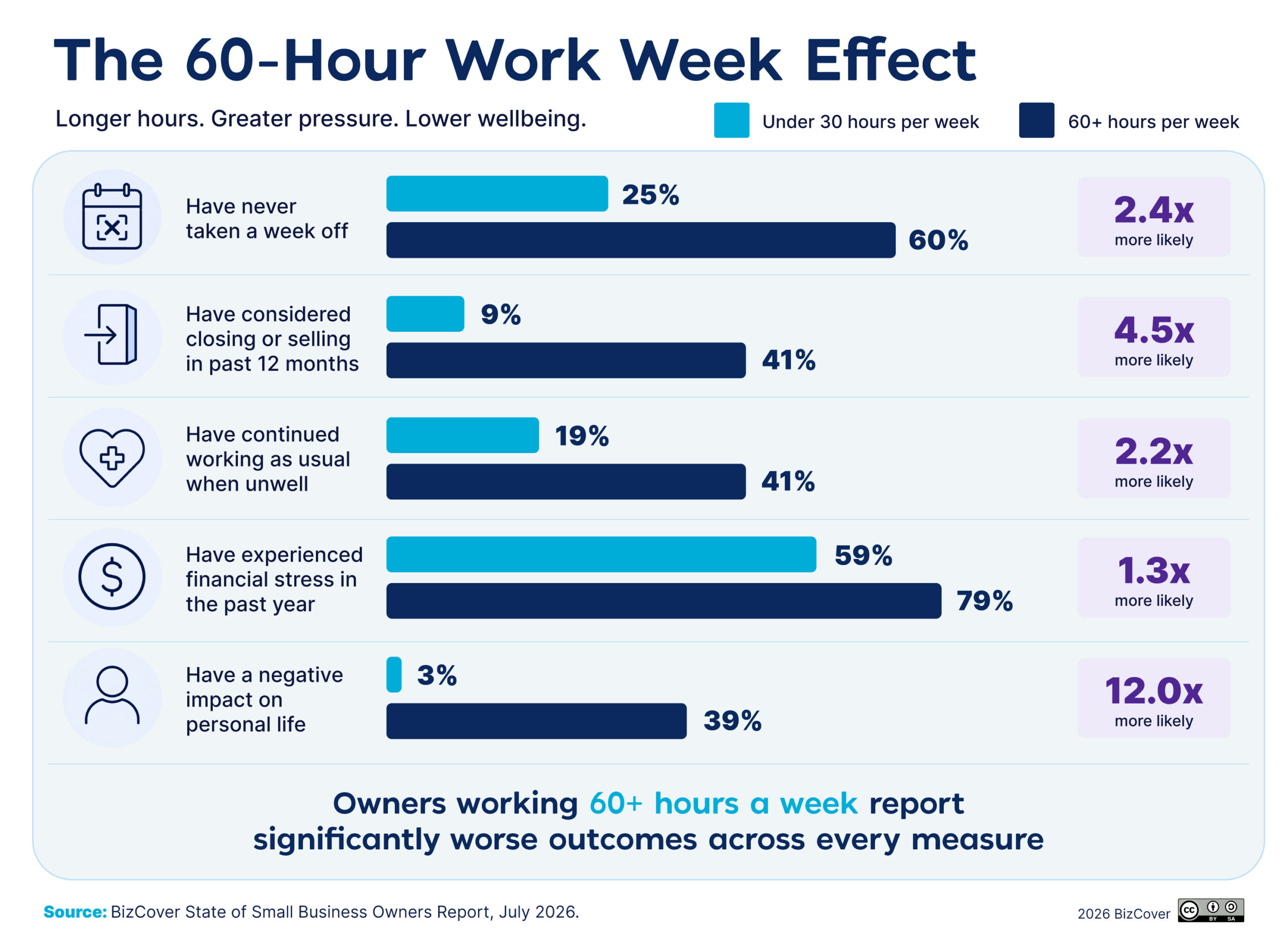
Extended hours and late nights have long been an accepted part of the small business owner experience. But the findings from this report suggest that once workloads reach a certain point, the negatives strongly begin to outweigh the positives. Across almost all survey questions asked, respondents working 60 hours or more per week reported significantly worse outcomes than those working less hours.
Hard work doesn’t always lead to a positive pay-off
Among owners working 60 or more hours per week, 60% say they have never taken a single week off while running their business.
Behaviours when unwell follow a similar pattern. More than two in five owners working 60+ hours (41.2%) say they continued working as usual when unwell, compared to fewer than one in five owners working less than 30 hours per week (19.1%).
Financial pressure also rises alongside workload. Nearly four in five owners working 60+ hour weeks (78.8%) report experiencing financial stress in the past year, compared to 58.9% of those working fewer than 30 hours.
What might be the most alarming takeaway is the impact on life outside of the business. Owners working 60+ hours are twelve times more likely to report that running their business has had a negative effect on their personal life, with 38.8% reporting a significant impact.
The symptom and the cause
Looking at this data, it could be interpreted that excessive workloads may be both a symptom and a driver of broader business challenges.
“Many small business owners accept long hours as part of the job, particularly during periods of growth or uncertainty,” says Miller “However, these findings suggest there may be a tipping point where longer hours stop being productive and instead begin contributing to poorer outcomes across multiple areas of life and business.”
As the data shows, owners working the longest hours aren’t just reporting higher stress levels, but are also more likely to experience financial pressure, work through illness and avoid taking holidays. They are also the most likely to have considered recently selling or closing their business (61%).
What owners sacrifice most
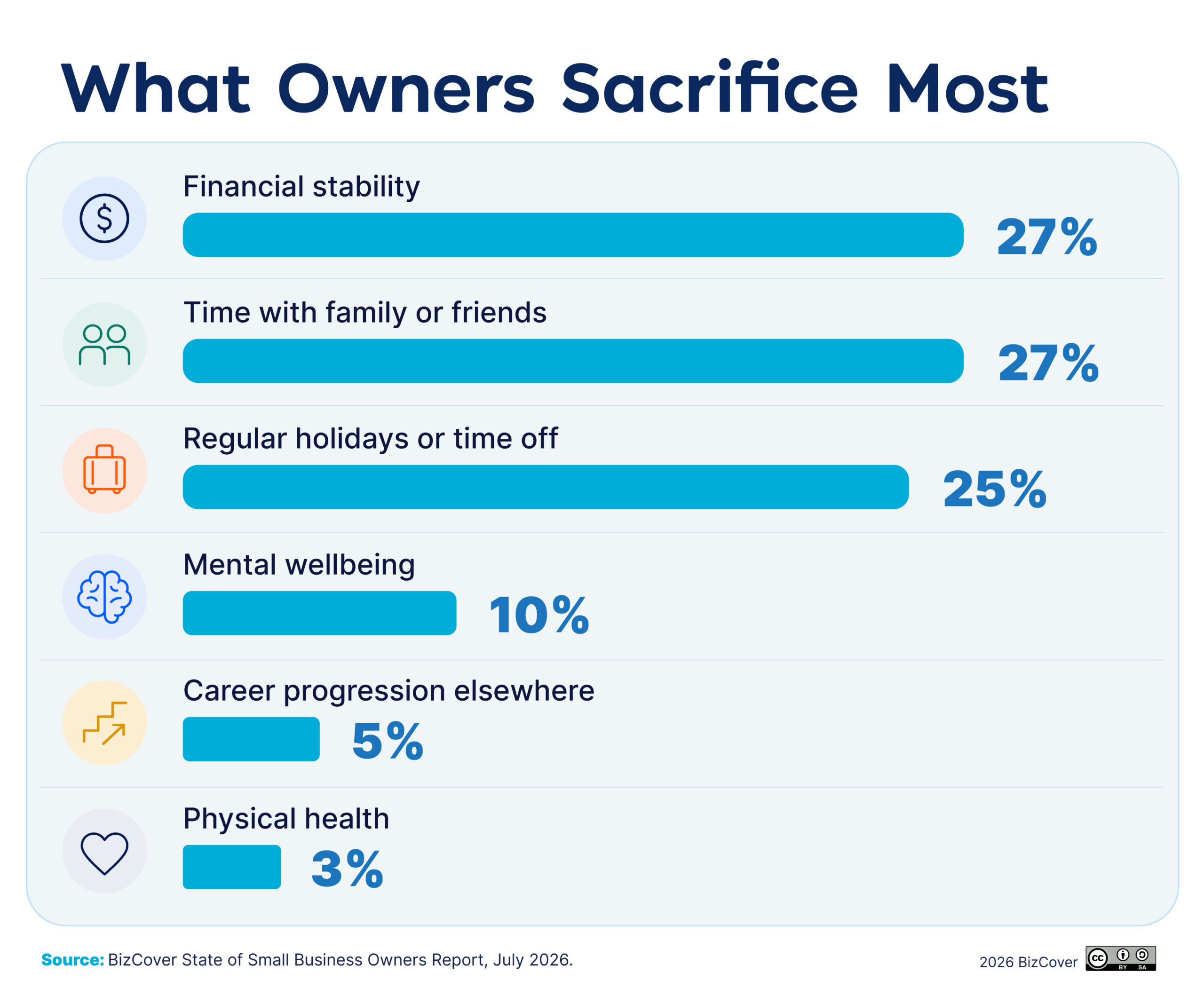
The findings suggest that for many owners, running a business means giving up things that matter in other parts of life: relationships, financial security, holidays, wellbeing and personal opportunities.
The two most common sacrifices are financial stability and time with family or friends, both cited by 26.5% of owners.
“This suggests that many owners are not only investing financially in their businesses, but are also sacrificing valuable personal time,” comments Miller.
Regular holidays and time away from work follow closely behind, with 25.1% identifying this as one of the biggest sacrifices they have made. Given that nearly one third of owners report never taking a full week off while running their business, the finding reinforces how difficult it can be for many owners to truly step away from work.
“Small business owners frequently wear multiple hats and carry significant responsibility. Over time, that can affect how much time they have for family, how often they take a break or even how secure they feel financially,” says Miller.
Nobody gets it
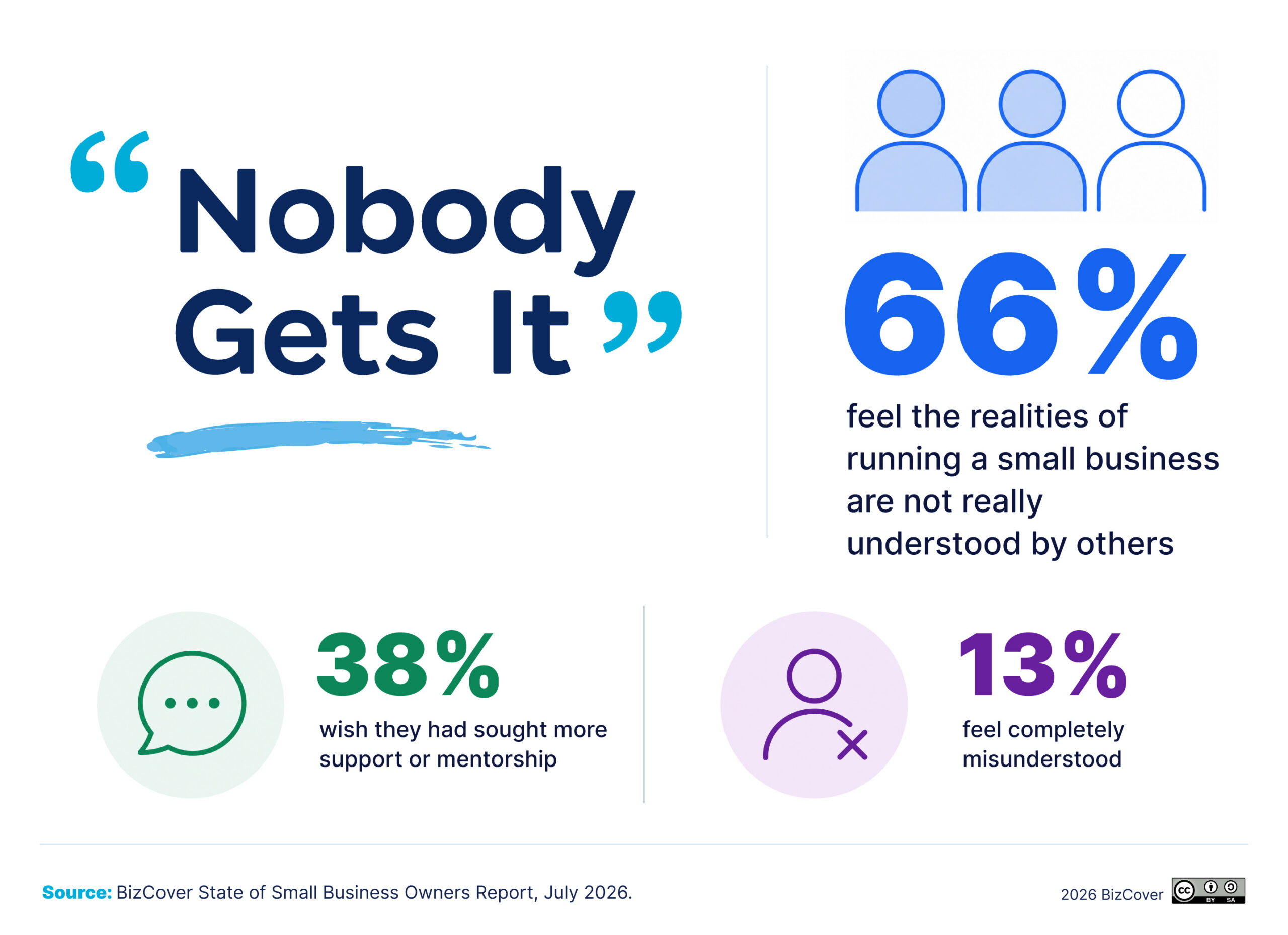
Public conversations about small business often focus on growth, success and economic contribution. But the survey suggests a different, invisible reality also exists: one shaped by isolation, constant pressure and the sense that the emotional load of running a business is difficult to explain to anyone who has not lived it.
That feeling comes through clearly in the data. 66% of owners said the realities of running a small business are not understood by others most or some of the time; while12.9% feel completely misunderstood. Again, this points towards the idea that small business ownership can be somewhat isolating, and that no one else understands the burden or sacrifices made to keep things running.
The Millennial squeeze
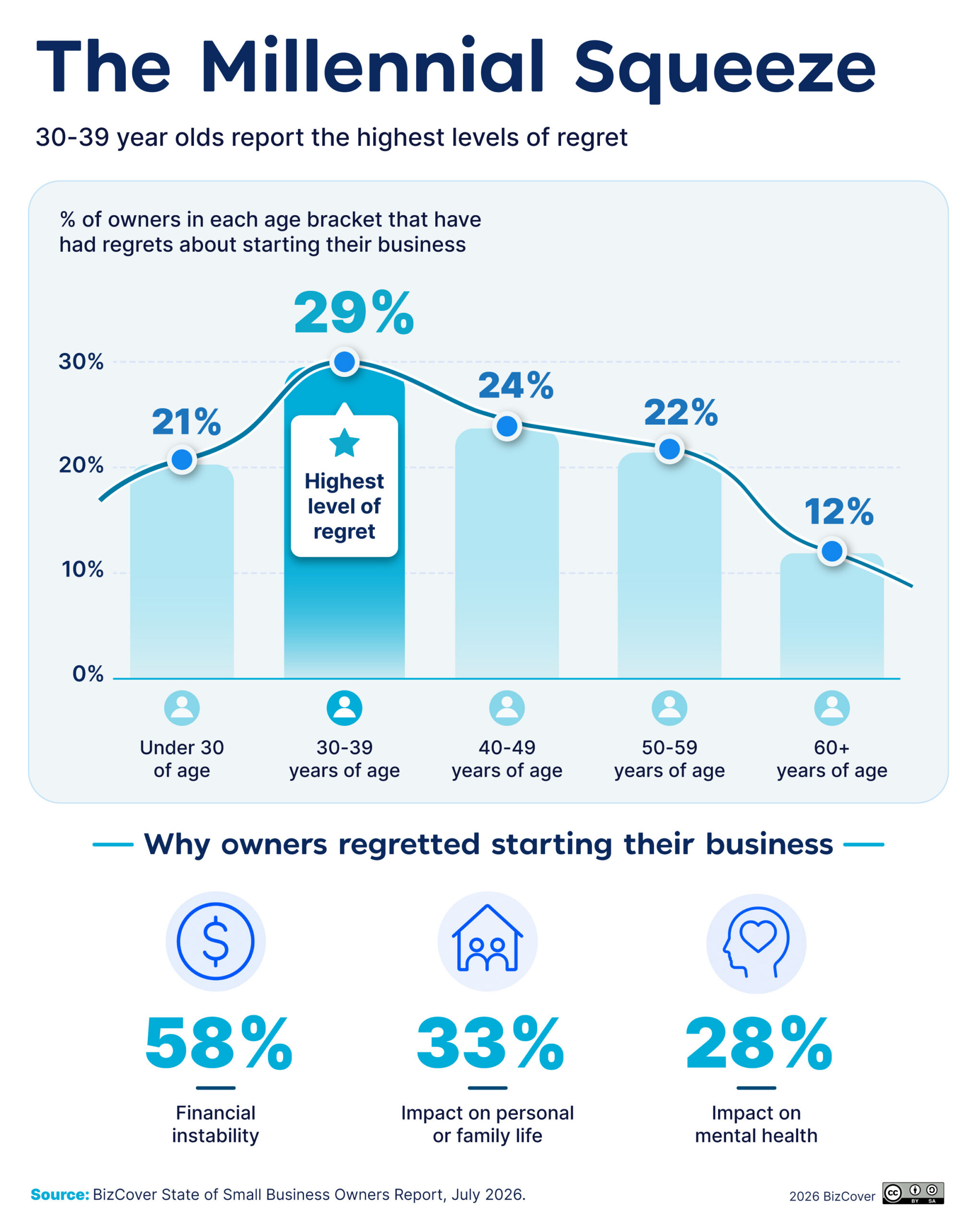
The challenges of running a small business are not felt equally across all stages of life. Owners aged 30-39 consistently reports some of the highest levels of stress and regret across the survey.
The pressure peak years
For many Australians, their thirties are a period when multiple responsibilities collide. Business growth ambitions often coincide with mortgages, young families and increasing financial commitments. Added to these pressures is the current cost of living crisis.
Business owners aged 30–39 recorded the highest level of regret of any age group, with 28.6% saying they have regretted starting their business at some point. This compares with 23.7% of owners aged 40–49, 21.8% of those aged 50–59 and just 11.4% of owners aged 60 and over.
Owners aged 30—39 are also the most likely to report experiencing significant financial stress, with 30.2% describing their financial stress levels as “significant”. Among owners aged 60 and over, that figure falls to just 13.8%.
“I don’t think these figures show that millennials are less committed to their businesses than other age groups,” says Miller. “Older business owners are not immune to stress. It simply reflects the reality of trying to balance competing responsibilities.
“For millennial business owners, they’re trying to run a business as well as – more than likely – pay a mortgage and start or raise a family.”
The data highlights that for many small business owners, success is not simply about business performance but is also shaped by what is happening outside the business.
The 8-year wall
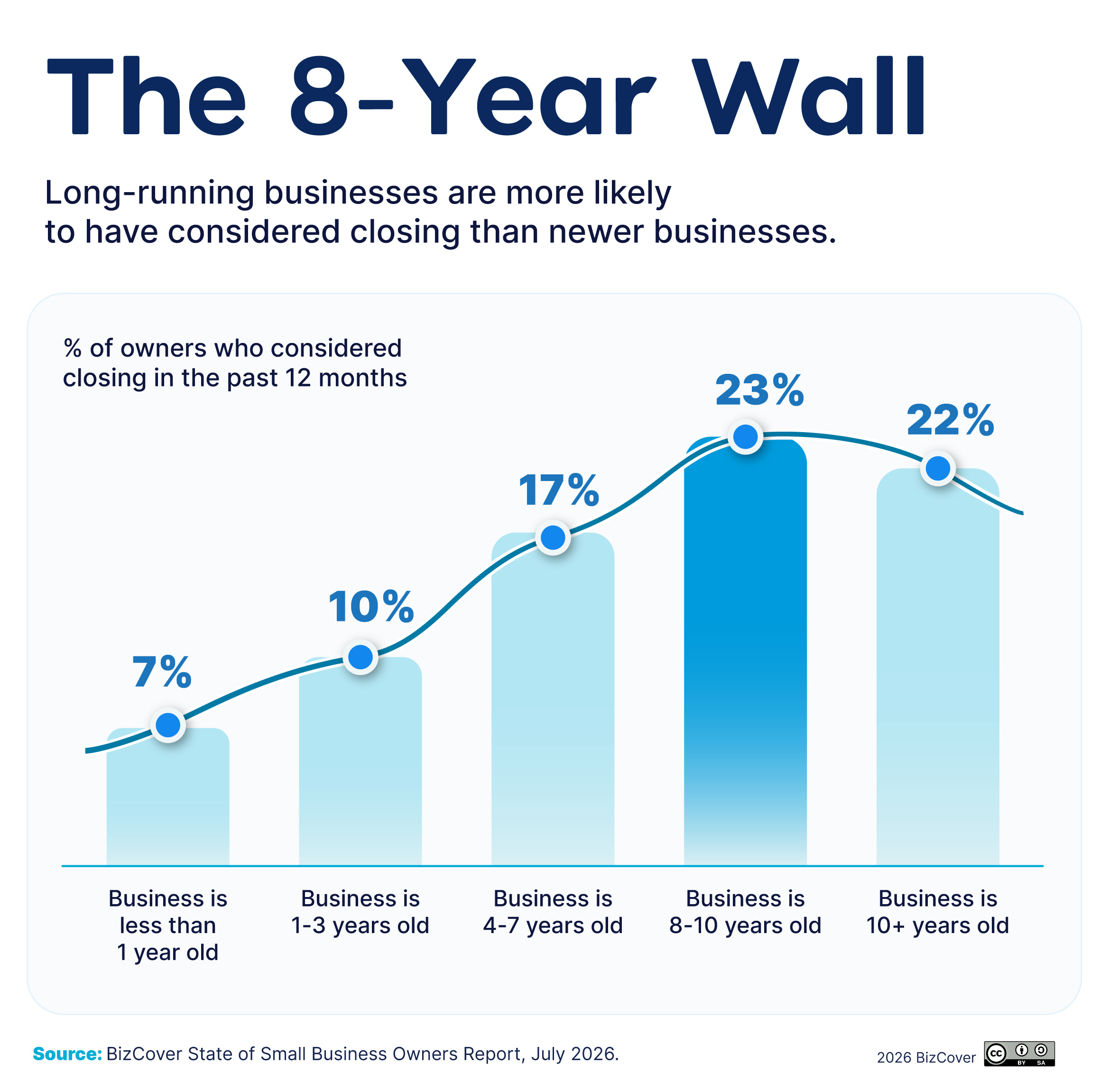
The early years are often seen as the hardest: establishing a customer base, generating consistent revenue and surviving the uncertainty that comes with starting something from scratch. But the findings from this report suggest a different story: the longer a business has been operating, the more likely its owner is to have considered closing down within the past 12 months.
Among owners in their first year of business, just 6.6% say they have considered closing. That figure reaches 10.4% among businesses operating for one to three years and 16.7% among those running for four to seven years.
By the time businesses reach eight years or more, the numbers increase sharply. Almost one in four owners running businesses for eight to ten years (23.4%) have considered closing in the past year, while 22.3% of those operating for more than a decade report the same.
“While owners become more experienced, knowledgeable and capable over time, they may also accumulate years of financial responsibility, workload pressure and personal sacrifice. In other words, they’re exhausted,” says Miller. “These numbers point to a much broader sustainability challenge rather than simply a workload issue.”
That said, owners running businesses for eight to ten years report the highest levels of being “very proud” of what they have built, with 60.6% selecting this response. So the owners who are most likely to be questioning the future of their business are also among the proudest of what they have achieved.
What small business owners would do differently if they could start over
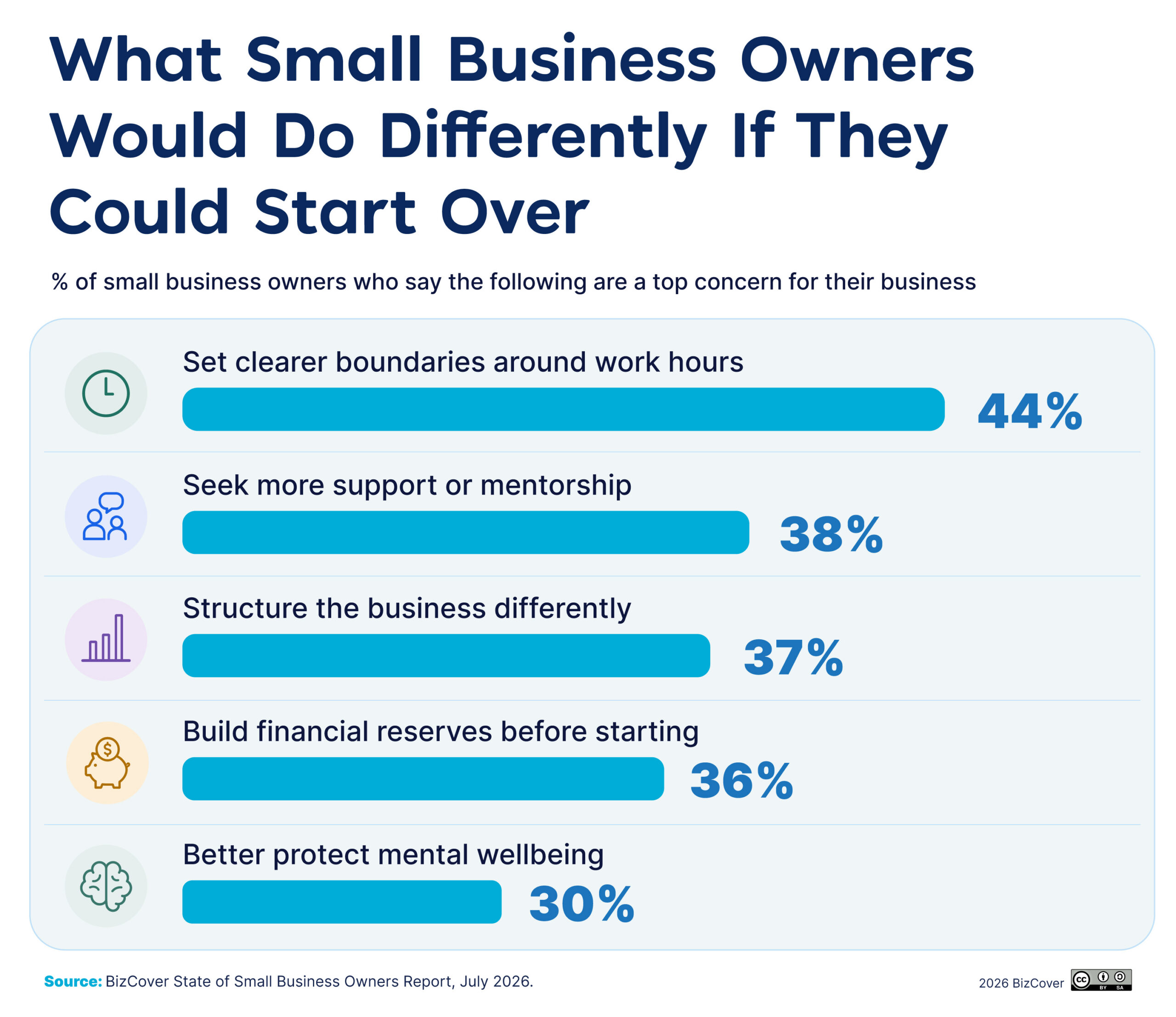
An overwhelming majority of business owners still say they have never regretted opening their business (78.7%). But that doesn’t mean they haven’t thought about what they would do differently if they could start again.
The biggest lessons learned
The number one change business owners would make would be setting clearer boundaries around work hours, selected by 43.5% of owners.
More than one third (38.2%) say they would seek additional support or mentorship if given the opportunity to start again, suggesting that the experience of running a business can often feel more isolating and lonely than expected.
Other common lessons include structuring the business differently from the outset (36.6%), building stronger financial reserves before launching (35.5%) and taking more proactive steps to protect their mental wellbeing (30%).
When put all together, these findings suggest that many owners underestimated the personal demands of business ownership rather than the commercial challenges alone.
Younger business owners appear particularly aware of the importance of boundaries. Among owners under 30, nearly six in ten (58.6%) say they would set clearer limits around their working hours if they were starting over.
Why they still do it
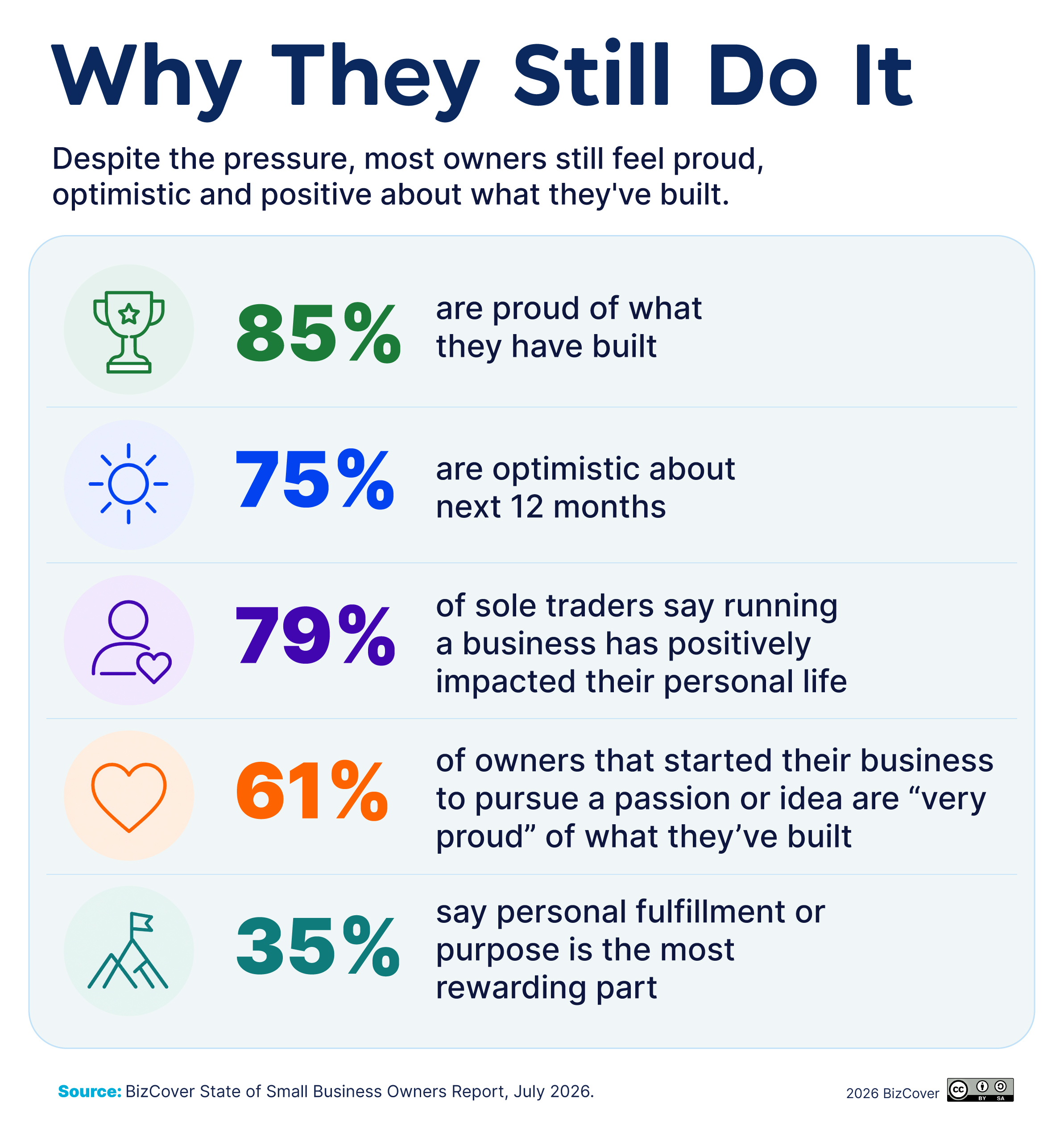
After exploring the pressures, sacrifices and challenges facing small business owners, one question remains: why do small business owners keep going?
The answer appears throughout the data. Despite the financial stress, long working hours and personal sacrifices highlighted elsewhere in this report, findings show most business owners still believe the rewards outweigh the costs.
In fact, 78.7% say they have never regretted starting their business, while almost half (49.2%) say they would never consider closing or selling it.
In addition, an overwhelming 85.4% of business owners say they are proud of what they have built; and nearly three quarters (74.6%) remain optimistic about the future of their business, despite the economic uncertainty and challenges many continue to face.
When owners were asked about the most rewarding aspect of running a business, personal fulfilment and purpose ranked highest (34.7%). In contrast, only 10.5% identify financial rewards as the most satisfying part of running a business.
“While financial success is important, it is rarely the sole reason people choose to start or continue running a business,” says Miller. “For many business owners, pursuing a passion, maintaining their independence and creating something they can be proud of creates a sense of purpose and fulfillment that exceeds financial gain.”
Purpose over profit
The results also help explain one of the central contradictions highlighted throughout the report. Even among owners who have experienced stress, burnout or financial pressure, many continue to feel positive about their decision to become business owners.
“Small business ownership can be incredibly demanding, but it can also be deeply rewarding,” says Miller. “The fact that personal fulfilment ranks so much higher than financial reward tells us something important.” He continues, “What stands out in this research is that many owners continue to find purpose and meaning in what they do, even when they’re facing significant challenges.”
Portrait of a modern Australian small business owner
This paradoxical balancing act between pride, resilience and pressure now appears to define the modern small business experience for many Australians.
What stands out most is that the various pressures owners feel are rarely temporary. Across the survey, the effects of running a business appear to build over time, particularly when it comes to workload, financial stress, burnout and the sustainability of the business itself.
Even so, the report makes clear that small business ownership continues to hold real personal value. Many owners still describe the experience as purposeful and deeply rewarding, even when the journey is difficult.
At BizCover, we work closely with SMEs every day, and this report reflects the realities many owners live with beyond the commercial side of running a business.
Insurance such as Personal Accident & Illness can cover your income if you’re unable to work due to illness or injury, even if you are
injured outside of work. Options are also available to provide lump sum benefits if you are permanently disabled or pass away. This type of insurance is often considered by sole traders, as it can help to provide a financial safety net when time away from work also means time away from income.
If you are reviewing your business cover or looking to better understand your options, talk to our friendly team.
Methodology
This July 2026 report is based on a survey of 1,500 existing BizCover small business customers in Australia.
The survey explored the realities of running a small business in Australia today, including workload, financial stress, business confidence, personal wellbeing, regret, optimism, support networks and long-term sustainability.
The analysis includes both overall survey findings and selected crossovers by age, hours worked, business tenure, business size and motivations for starting a business.
Sectors represented in the survey include healthcare and allied health, fitness and beauty, retail and e-commerce, hospitality and food service, professional and consulting services, maintenance and repair services, trades and construction, and manufacturing.
This information is general only and does not take into account your objectives, financial situation or needs. It should not be relied upon as advice. As with any insurance, cover will be subject to the terms, conditions and exclusions contained in the policy wording or Product Disclosure Statement (available on our website). Please consider whether the advice is suitable for you before proceeding with any purchase. Target Market Determination document is also available (as applicable). © 2026 BizCover Pty Limited, all rights reserved. ABN 68 127 707 975; AFSL 501769.