The small business insurance gap: Are rising costs changing how SMEs manage risk?
Every small business carries risk. The question is how much of that risk a business owner is comfortable carrying themselves and how much they choose to manage through insurance.
New research commissioned by BizCover suggests rising costs may be making that decision increasingly difficult for Australian small businesses. Over 30% of small business owners surveyed do not currently hold any form of business insurance; and among sole traders, that rises to 45%.
BizCover General Manager Brad Miller says the findings highlight the difficult decisions small business owners can face when balancing protection against competing costs.
“We understand that small business owners are having to make tough calls as costs continue to rise. But when it comes to insurance, it’s important to consider not just the cost of cover, but also the potential financial impact of the risks a business may be choosing to carry itself,” he says.
Key takeaways
- 33% of small business owners surveyed do not currently hold any form of business insurance.
- Among sole traders, that rises to 45%.
- 59% of insured small businesses know or suspect at least one gap in their current cover.
- 19% aren’t confident their current insurance would adequately cover their business if they needed to make a major claim.
- Among businesses that may be underinsured, 51% say the cost of expanding their cover is too high.
- 44% say they have assessed the risks and decided to take the chance for now.
- 73% of insured businesses experienced an increase in their total insurance premiums over the past 12 months.
- 43% accepted their last renewal without comparing other options.
Are Australian small businesses facing an insurance protection gap?
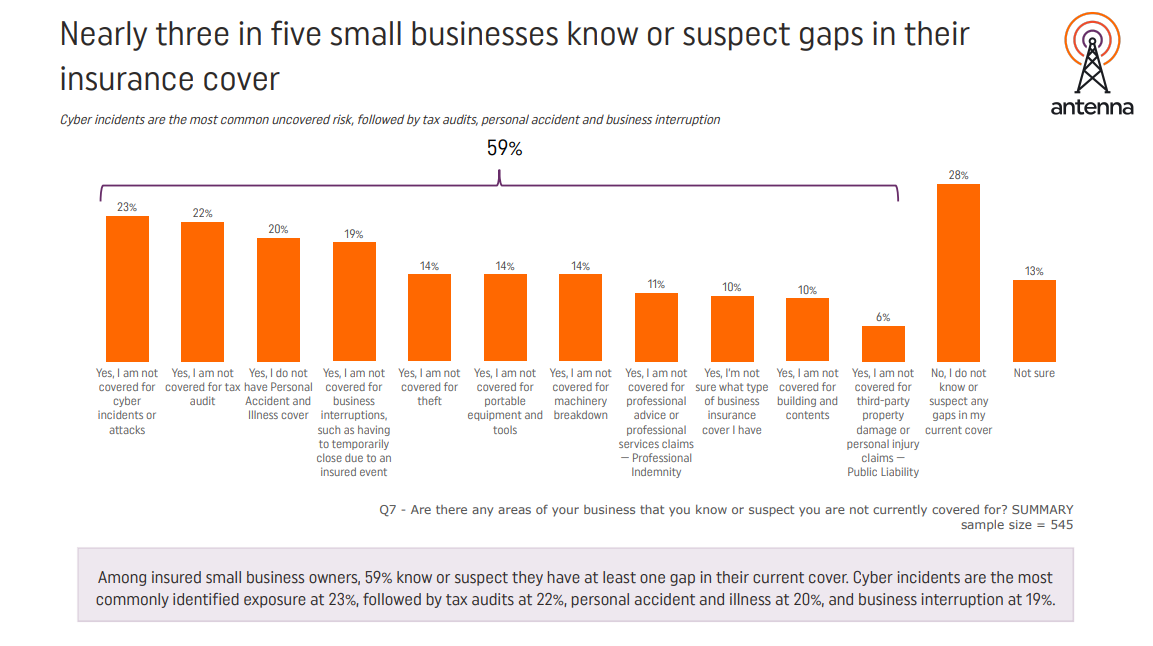
Among business owners who do hold insurance, cover gaps may still exist. This can potentially expose a business to certain risks.
Nearly three in five insured small business owners (59%) know or suspect there is at least one area of their business they aren’t currently covered for. The most commonly identified potential gap was cyber incidents or attacks (23%), followed by tax audits (22%), personal accidents and illnesses (20%) and business interruptions (19%).
Other areas identified included theft, portable equipment and tools, machinery breakdown and building and contents, and specifically Professional Indemnity insurance and Public Liability insurance.
It is important to note, however, that not every type of insurance will be relevant to every business. All small businesses are different and face different risks, so the types and level of cover a business considers may vary depending on its circumstances.
What these figures do show is that many insured business owners recognise there may be risks their current policies do not address.
How confident are SMEs in their cover?
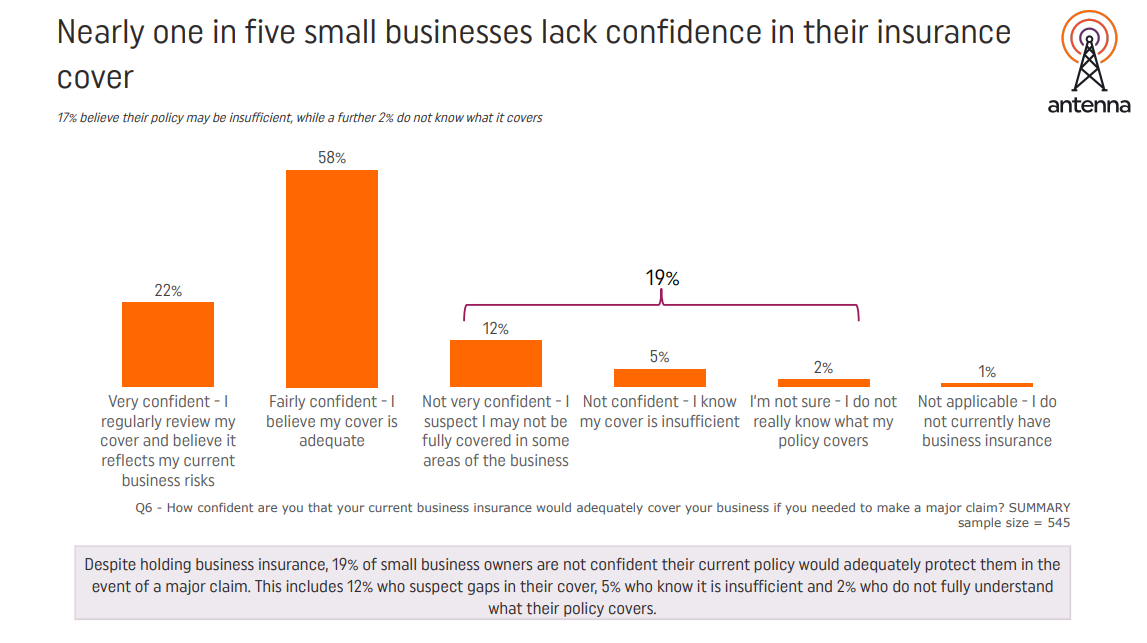
Despite these potential gaps, most insured business owners remain broadly confident in their insurance.
When asked whether their current business insurance would adequately cover their business if they needed to make a major claim, 80% said they were either very or fairly confident.
However, almost one in five (19%) lacked that confidence.
This included 12% who suspected they may not be fully covered in some areas of the business, 5% who knew their cover was insufficient and 2% who didn’t really know what their policy covered.
That distinction is important, because a business can have insurance while still choosing to retain some risks itself.
It is also possible for a business to change significantly after a policy is taken out.
“A business can change a lot in just 12 months,” Brad points out. “New equipment, additional employees, more stock, a move to different premises or new services are just some of the changes that could alter a business’s risk profile over time.
Why are some businesses choosing to have insurance gaps?
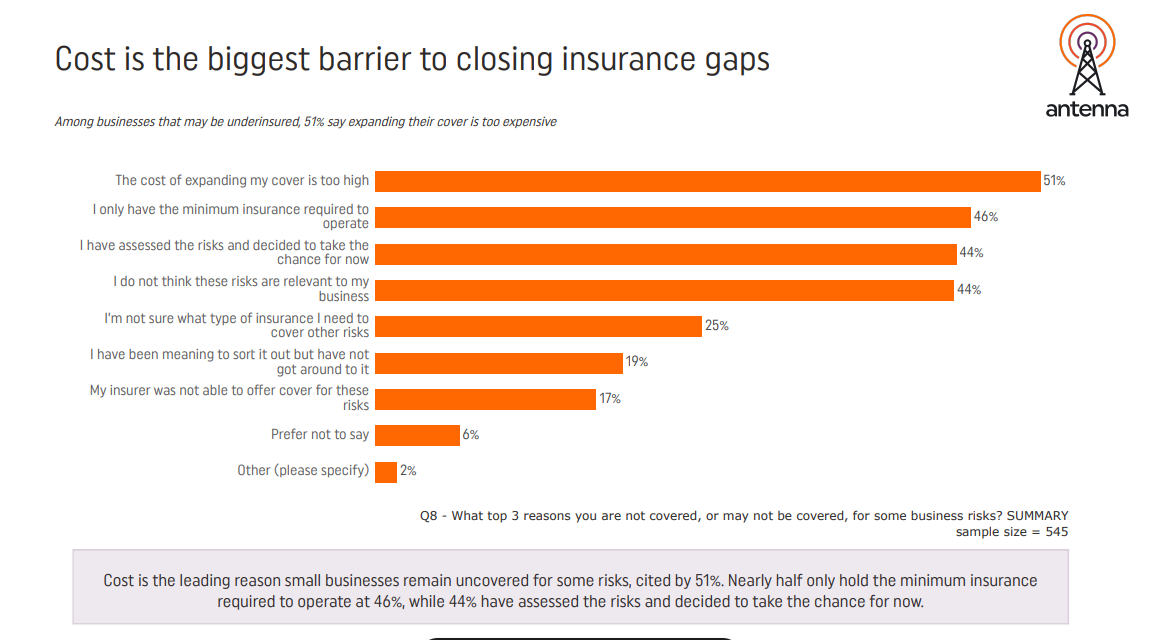
For businesses that know or suspect they may not be covered for some risks, cost is the most commonly cited barrier to expanding their insurance.
More than half (51%) said expanding their cover was too expensive. Another 46% said they only had the minimum insurance required to operate.
But the research also points to deliberate risk-taking. Some 44% said they had assessed the risks and decided to take the chance for now, while another 44% didn’t believe the uncovered risks were relevant to their business. And one quarter (25%) weren’t sure what type of insurance they would need to cover other risks.
“I think this shows that there isn’t one simple explanation for insurance gaps,” says Brad. “For some businesses it may be affordability. For others it may be a deliberate assessment of risk, uncertainty about available cover or a belief that a particular exposure just isn’t relevant.”
Rising premiums are adding another layer of pressure
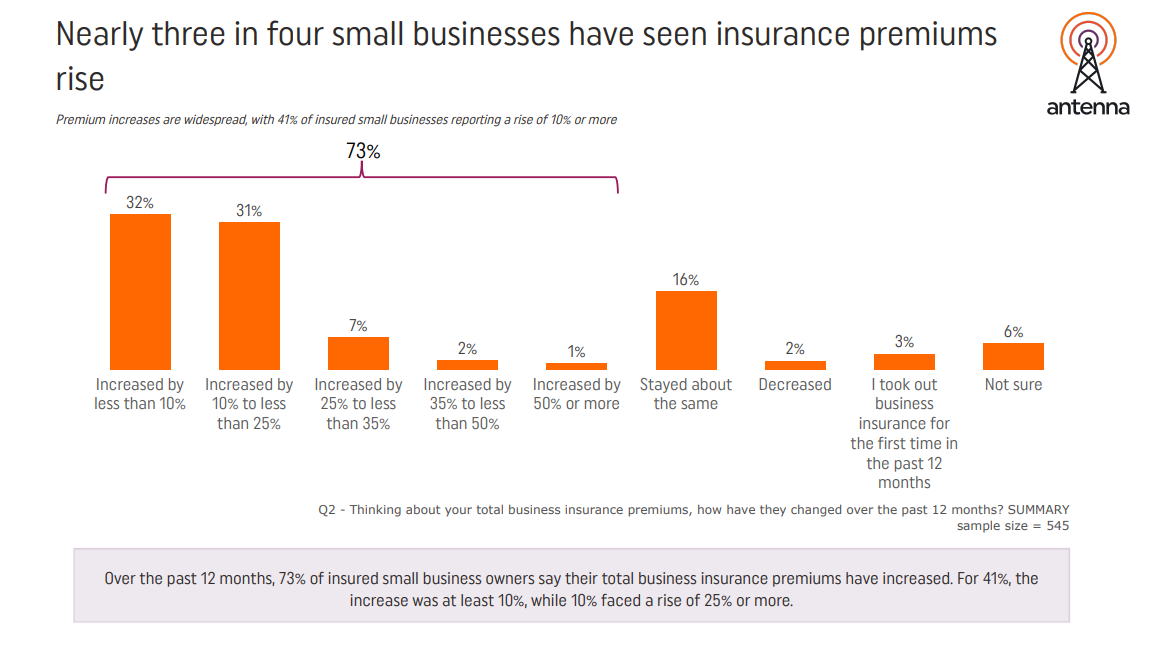
These decisions are being made against a backdrop of rising insurance costs.
Nearly three in four insured small business owners (73%) reported that their total business insurance premiums had increased during the past 12 months. For 41%, the increase was at least 10%, while one in ten experienced increases of 25% or more.
Almost one in four (23%) said rising costs had caused them to reduce, cancel or not renew some business insurance during the past year.
“These numbers tell us that financial pressure is affecting insurance decisions for some businesses,” says Brad. “When costs rise, business owners may find themselves having to think carefully about the level of risk they are comfortable retaining themselves.”
The research also found that insurance costs are outpacing business revenue for many SMEs. 34% said their premiums increased faster than their revenue, while a further 11% saw their revenue decline while insurance costs increased.
Renewal can be an opportunity to review your options
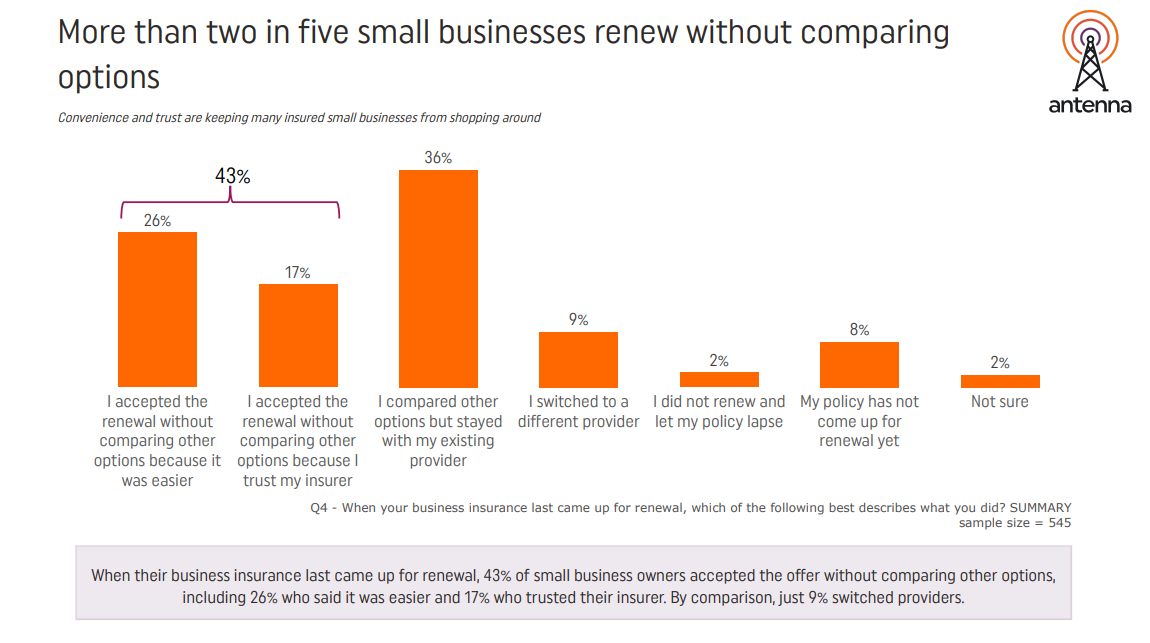
The research found 43% of insured small business owners accepted their last renewal without comparing other options. That included 26% who said they did so because it was easier and 17% because they trusted their insurer.
That doesn’t mean renewing with the same insurer is not your best option. In fact, another 36% compared other options and ultimately decided to stay with their existing provider.
Instead, renewal can provide a useful opportunity to take another look at your existing cover and consider the options available.
“It’s important to shop around and compare what’s available when it comes to business insurance,” says Brad. “Staying with an existing provider may still be the right choice. Comparing options simply gives business owners more information to help make that decision.”
Separate BizCover customer research conducted in 2025 found 80% of SMEs surveyed who switched insurers with BizCover reported saving money.
Savings aren’t guaranteed, and premiums and cover can vary depending on the business, policy and insurer. However, comparing options may help business owners better understand what is available before deciding whether to renew, switch or make changes to their cover.
Three things to consider when reviewing your business insurance
Reviewing insurance isn’t necessarily about buying more cover. It can simply be about understanding what you already have, identifying changes to your business and considering whether the options available still reflect your circumstances.
1. Has your business changed?
Brad’s first tip is: “Consider whether you’ve added employees, purchased equipment, increased stock, moved premises, introduced new services or made other significant changes since you last reviewed your insurance.”
As your business changes, the risks it faces may change too. Reviewing your policies when there are significant changes can help you understand whether your existing cover still reflects how your business operates.
2. What risks are you comfortable carrying yourself?
Insurance doesn’t remove every business risk. Consider the financial impact different events could have on your business and which costs you could realistically absorb yourself.
For example, how would your business respond if essential equipment needed replacing unexpectedly, an event forced you to temporarily close, or you faced a significant claim?
“Understanding the potential financial impact can help inform decisions about the risks you’re comfortable retaining,” says Brad.
3. Understand what’s covered and what isn’t
Price matters, but it isn’t the only consideration. Policies can differ in the risks they cover as well as their limits, exclusions and excesses.
Therefore, the cheapest option may not necessarily offer the same cover or features as another policy.
“Understanding what your policy includes – and where there may be gaps – can give you a clearer picture of the financial risks your business is retaining,” says Brad.
Finding the right balance
Different businesses face different risks, have different financial circumstances and may make different decisions about the risks they’re willing to carry themselves. But the research suggests rising costs are making those decisions increasingly important.
For some SMEs, that may mean reviewing whether their existing insurance still reflects the business they operate today. For others, it may mean comparing available options before deciding whether to renew.
There is no single approach that will suit every small business. But understanding what you have, what has changed, and what options are available can help you make a more informed decision about how you manage business risk and insurance costs.
“Comparing cover options allows small business owners to gain greater visibility over what’s available and how different options compare. It can also help them consider the balance between cost, cover and the risks they are prepared to retain themselves,” concludes Brad.
BizCover allows you to compare business insurance quotes in minutes. Find out whether you could save money by switching.
Methodology – Antenna
Antenna, an independent consumer research agency on behalf of BizCover, conducted an online AntennaPoll survey of n=545 Australian small business owners who currently have insurance. The survey was conducted between 1 and 13 of July 2026. Respondents were recruited nationally across all states and territories through an accredited online research access panel. The study was designed to capture the experiences and perspectives of this specialist audience.
Methodology – BizCover primary data
BizCover analysed pricing data for Australian customers, comparing FY24, FY25 and FY26 paid-annually prices and annualised costs for customers paying monthly across different industries and ANZSIC classifications. Year-on-year changes were calculated by comparing the relevant financial year with the previous year. The analysis reflects BizCover customer pricing data and is not intended to represent insurance pricing across the broader Australian market.
“Customer savings” data was not part of the survey. A separate BizCover customer savings survey from 2025 identified that 80% of SMEs saved when switching to BizCover.
This information is general only and does not take into account your objectives, financial situation or needs. It should not be relied upon as advice. As with any insurance, cover will be subject to the terms, conditions and exclusions contained in the policy wording or Product Disclosure Statement (available on our website). Please consider whether the advice is suitable for you before proceeding with any purchase. Target Market Determination document is also available (as applicable). © 2026 BizCover Pty Limited, all rights reserved. ABN 68 127 707 975; AFSL 501769.